Collaborations
The Department of Performing Arts’ spirit of collaboration manifests in numerous interdisciplinary projects every year, professional partnerships in music and theater, and collaborations across faculty and students.
The PostClassical Ensemble (PCE), a Washington, DC-based chamber orchestra, is proudly designated as the ensemble-in-residence at Georgetown University. Under the leadership of Music Director and Georgetown faculty member Angel Gil-Ordóñez, PCE comprises some of the region’s finest musicians and is celebrated for its creative programming that integrates classical music with historical and cultural narratives.
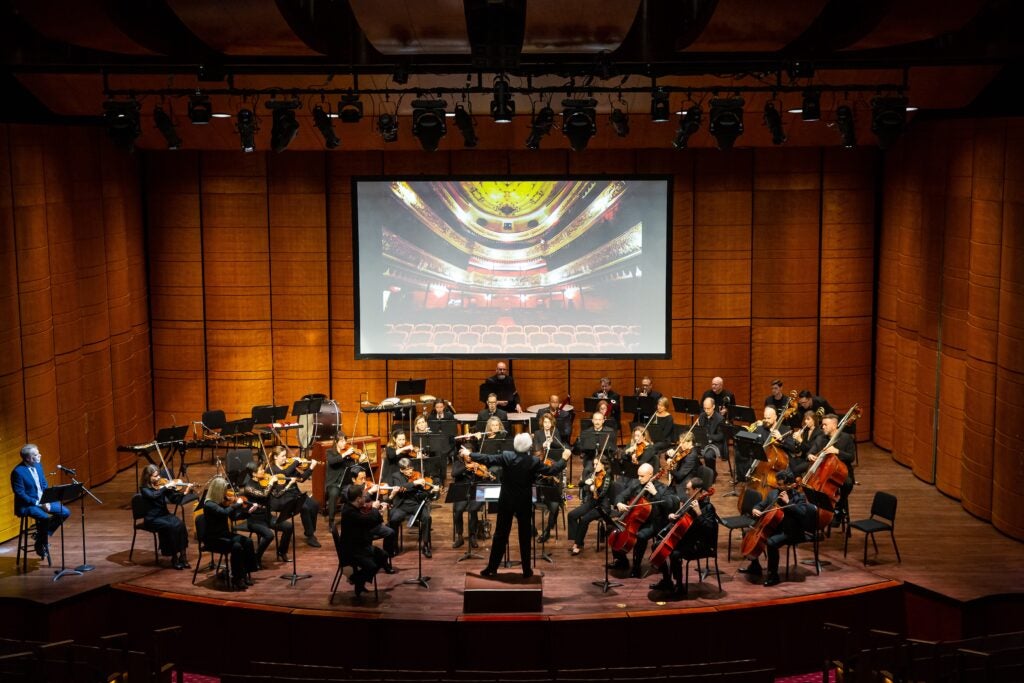
Georgetown music students benefit from PCE’s presence through orchestral and chamber coaching, masterclasses, workshops with visiting artists and composers, and educational outreach in DC-area schools. Students also gain real-world experience through administrative fellowships in education, production, development, and marketing. PCE’s frequent performances, including at Georgetown’s Friday Music Concert Series and the Kennedy Center, offer direct access to professional orchestral practices.
PCE’s 23rd season takes a broad look at the American musical experience and the ideas that shape it. The 2026-27 season explores the era of the classic American Popular Song, celebrates Pulitzer Prize-winning Cuban-American composer Tania León, examines the intersection of folk and classical music, and invites audiences into conversation with a neuroscientist about how the brain is impacted by music. Guided by visionary guest curators and brought to life by outstanding performers, the season offers music, history, and discovery — illuminating how music reflects, challenges, and deepens an understanding of the world around us.
Season Preview
Your Brain on Music: Sound, Science, and Soul

- On November 16 & 17, 2026 at 6:30 pm.
- At the Johns Hopkins University Bloomberg Center, 555 Pennsylvania Ave NW, Washington, DC 20001.
Your Brain on Music celebrates PCE’s new collaboration with Johns Hopkins University’s Alexander Grass Humanities Institute. A unique program, curated by Dr. Daniel Weinberger, Professor at the Hopkins School of Medicine and Director of the Lieber Institute for Brain Development, will explore how our brains interact with music and images. Brain scans, film clips, and scientific commentary harmonize with works by Bach, Pachelbel, Nino Rota, Felipe Lara, and a complete performance of Beethoven’s Eighth Symphony.
Tickets available here.
Amazing Grace: Honoring Tania León

- On January 13, 2027 at 7:30 pm.
- At Lohrfink Auditorium, Rafik B. Hariri Building, Georgetown University, Washington, DC 20057.
PCE’s seasonal tradition ringing in the New Year, Amazing Grace, returns with a stirring program for chamber orchestra and vocal soloists celebrating the universal expression of the human spirit through music. Our 2026-27 guest curator and honoree is the Pulitzer Prize-winning composer, Tania León. Celebrating her Cuban‑American roots and her contributions to the orchestral repertoire, we also spotlight the music that has shaped her journey as a composer, taking audiences on a spiritual journey through works by Silvestre Revueltas, Samuel Barber, Duke Ellington, and Haydn. Featuring soprano Melissa Wimbish.
Celebrating Alan Lomax: From Appalachia to Galicia

- On March 31, 2027 at 7:30 pm.
- At Lohrfink Auditorium, Rafik B. Hariri Building, Georgetown University, Washington, DC 20057.
During a 60-year career, ethnomusicologist Alan Lomax worked to record, preserve, and promote the folk music of the world, seeking to document the sounds of America for the Library of Congress before taking his enterprise abroad. His global field recordings have inspired musicians and composers from around the globe. In this program guest curated by performers, ethnomusicologists, and folklorists Jennifer Cutting and Stephen Winick, PCE will take you on a tour of Lomax’s musical worlds — from lilting Irish dances and love songs to heartbreaking blues and ballads. You’ll hear folk music in sparkling contemporary arrangements, Blues and banjo tunes, and compositions drawing on the deep well of traditions that Lomax’s work uncovered, including works by American classical composers Aaron Copland and Ruth Crawford Seeger. Featuring special guests, including the OCEAN Quartet and Washington Revels Jubilee Voices.

The Music Policy Forum (MPF), founded by Georgetown alumnus Michael Bracy (CAS ’90), is a dynamic non-profit leadership network that promotes collaboration among musicians, music businesses, government officials, non-profits, researchers, and philanthropists to develop strong, equitable, and sustainable music ecosystems through innovative policies and models. Since its inception in 2017, MPF has been closely connected with Georgetown University, providing rich opportunities for public conferences and convenings, especially the Music Industry Seminar. This seminar is a cornerstone of MPF’s educational initiatives at Georgetown, offering students and faculty deep insights into the music industry through direct access to a vast network of leaders.
Additionally, MPF co-sponsors the annual Music Ecosystem Forum at Georgetown University, a major event that gathers diverse stakeholders to discuss strategies for advancing music ecosystems. This forum facilitates dialogue on critical issues such as equity, sustainability, and the future of musical labor, combining academic research with practical industry insights. Through these initiatives, including the Music Industry Seminar and the Music Ecosystem Forum, Georgetown’s Department of Music and MPF collaborate to integrate scholarly perspectives with real-world practices, enriching the educational landscape and contributing to the ongoing discourse in music policy.